

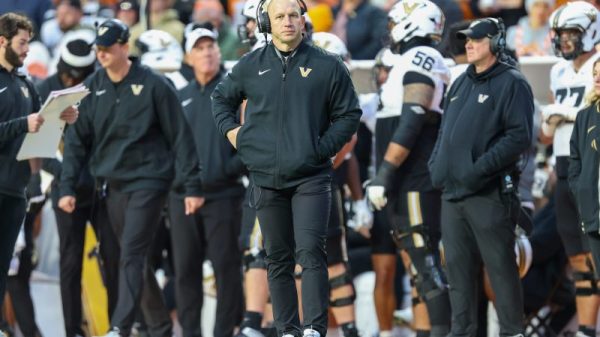
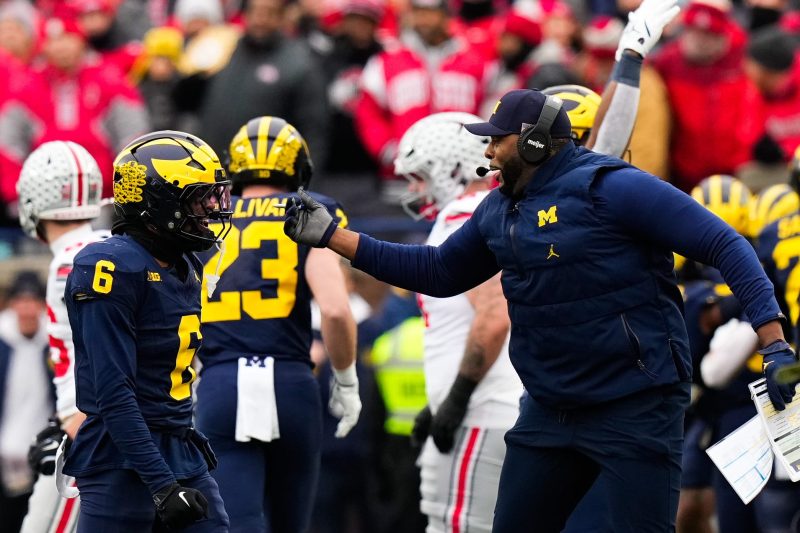
Michigan football coach Sherrone Moore was fired for cause on Wednesday, Dec. 10.
An investigation found credible evidence that Moore engaged in an inappropriate relationship with a staff member.
The relationship violated University of Michigan policy which prohibits supervisors from initiating intimate relationships with their supervisees.
Michigan football coach Sherrone Moore was fired Wednesday, Dec. 10, and the nature of his dismissal led to the university to immediately terminate him 11 days after the end of the regular season.
The university announced Moore was fired for cause after an investigation showed ‘credible evidence was found that Coach Moore engaged in an inappropriate relationship with a staff member.’ Michigan athletics director Warde Manuel added the conduct was a ‘clear violation of University policy, and U-M maintains zero tolerance for such behavior.’
Getting fired for cause means the school believes was a satisfactory reason to dismiss someone, and in Moore’s case, the Wolverines coach violated university policy. Typically, reasons to be fired for cause are laid out in the contract for the job, and that was clearly stated for Moore. But what is the university policy, and what did it say in Moore’s contract?
What Sherrone Moore contract says about being fired
The grounds to fire Moore with cause were laid out in university policy and in his contract. In Section 4.02 of the contract, it states ‘the university has the right to terminate employment of the head coach for cause in the event of any of the following:’
Failure of the Head Coach in any material respect to perform the services required of him under this Agreement.
Conviction of the Head Coach of any criminal offense involving fraud; or conviction of any felony; or commission of any act which results in material injury to the reputation of the University.
Conduct by the Head Coach which offends against public decency or morality, as shall be determined by the standards prevailing in the community or which results in, or in the reasonable determination of the University could result in, material injury to the reputation, interests or obligations of the University or the Program.
Misconduct as defined in Sections I and IIA of the University of Michigan Standard Practice Guide 201.12. The parties agree that the definition of misconduct set forth in sections I and II of Standard Practice Guide 201.12 is incorporated into this Agreement as cause for discharge, but no other part of SPG 201.12 will apply to the Head Coach’s employment.
Deliberate or serious rule violation(s) as set forth in Sections 2.04 and 2.05 of this Agreement.
If the Head Coach knows of a serious violation of NCAA rules by a coach, staff member, athlete, or other representative of the University’s athletic interests and fails to promptly report it to the Athletic Director of the University or the Compliance Services Office.
Fraud or dishonesty in the performance of any of the duties or responsibilities under the Agreement.
Participation in any job searches or interviews for employment outside of the University of Michigan during the term of this Agreement without the knowledge of the Athletic Director.
If the Football team is found ineligible for postseason play as a result of Team APR
Section 2.06 of Moore’s contract also states, ‘The head coach shall represent the university positively in public and private forums and shall not engage in conduct that reflects adversely on the university or the football program. The head coach shall perform his duties and personally comport himself at all times in a manner consistent with the high moral, ethical and academic standards of the university and its athletic department.”
‘A Supervisor may not, implicitly or explicitly, initiate or attempt to initiate an Intimate Relationship with a Supervisee over whom they exercise supervisory authority,’ university policy states.
Since Moore had an ‘inappropriate relationship with a staff member,’ he violated university rules and provided the grounds to fire him for cause.
Sherrone Moore buyout
With Michigan announcing firing is for cause, the school is saying it is not legally required to pay Moore any buyout money. Moore could legally contest the firing for cause and the sides could also agree to a settlement.
If Moore had been fired without cause, his buyout would have been just over $13.7 million due to be paid in monthly installments through the end of his contract in January, 2029. He would have also been owed any bonuses for the 2025 season that had not yet been paid.
(This story was updated to add a video.)